
Revenue Systems Audit
A Revenue Systems Audit is Ryzodus’s systems-level approach to a MarTech stack audit. It examines the marketing technology, CRM, automation, integrations, attribution, and reporting infrastructure through which demand becomes revenue—including the systems used by marketing, sales, and operations.
It is broader than a digital marketing audit focused on campaigns or channel performance. It examines the digital infrastructure those activities depend on.
An Audit of the Digital Systems Behind Revenue
This is not an audit of your books, and it is not a generic marketing review.
We conduct a holistic examination of the connected digital systems through which demand becomes action: your website and forms, CRM, automations, lead routing, attribution, integrations, and reporting.
Each tool may appear to work on its own. The question is whether they work together well enough to tell the same story, support sound decisions, and change without creating new problems downstream.
A Revenue Systems Audit establishes how the MarTech stack and connected revenue system actually behave—not just how they were intended to behave, or how the documentation says they work.
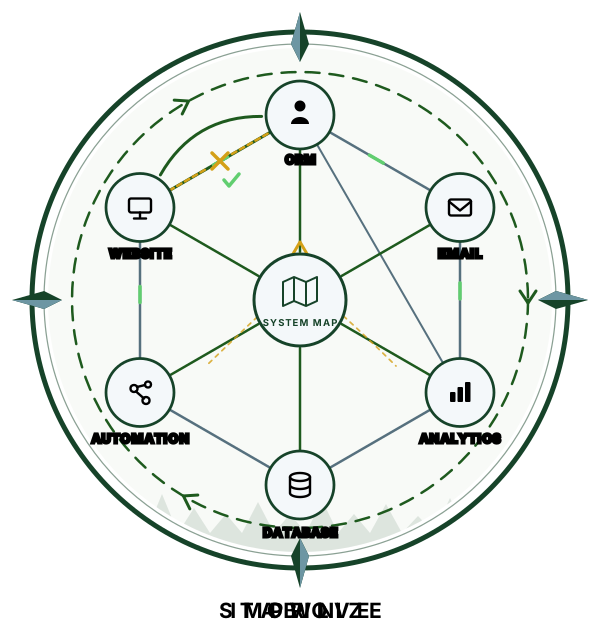
The System Works Until You Need to Change It
The system works, but changes feel risky?
Leads still arrive. Automations still run. Reports still populate. From the outside, nothing appears seriously broken.
Then someone needs to change a form, update lead routing, connect a new platform, or modify the CRM—and certainty disappears.
No one can confidently explain which systems depend on the change, which fields are being overwritten, or what automation will react downstream. What looked functional begins to feel fragile.
This is how revenue systems decay: not through one obvious failure, but through years of reasonable changes made without a complete view of the system.
A Revenue Systems Audit looks beneath that functional surface before another change is added.
What appears to be working at the system level
- Leads are entering the CRM. Sales sees new records arriving, but that does not tell us whether leads are being dropped, duplicated, or stripped of their original context.
- Automations are still running. Tasks, emails, and notifications continue firing, but activity alone does not prove that the right logic is being applied.
- Dashboards are updating. The numbers look current, but the fields and definitions beneath them may no longer tell the same story.
- Sales continues moving. People compensate with judgment, spreadsheets, and manual workarounds—often hiding weaknesses in the system itself.
What no one can confidently answer
- Where did this value come from? It may have originated in a form, integration, import, automation, or human edit.
- What writes to this field? Multiple workflows or connected platforms may update the same value under different conditions.
- Which automation controls routing? Assignment logic may be distributed across the CRM, integration tools, forms, and custom code.
- What breaks if we change it? A small adjustment can affect ownership, follow-up, attribution, notifications, and reporting downstream.

You May Not Have a Tool Problem
When a CRM becomes difficult to trust, the natural conclusion is that the platform is broken.
Salesforce feels too complicated. HubSpot appears easier. ActiveCampaign promises simpler automation. Someone recommends adding another tool or replacing the one already there.
Sometimes that is the right decision.
But tools are often where deeper system problems become visible, not where those problems began.
Over time, different employees, consultants, managers, and vendors make reasonable changes to solve immediate needs. Fields are added. Automations are patched. Integrations are connected. Exceptions become permanent. The people who understood those decisions eventually leave, but the configuration remains.
What is left is a foundation the business depends on, but no one fully understands—or wants to own.
Adding another platform to that foundation does not remove the unknowns. It can create another place for data, logic, and responsibility to diverge.
A Revenue Systems Audit separates actual platform limitations from problems of architecture, configuration, process, and ownership. It may confirm that a tool should be replaced. Or it may reveal that the existing tools are capable, but the system around them needs to be understood and stabilized first.
Follow the Signal, Not the Interface
Every platform presents its own interface, terminology, and version of the story. None of them necessarily shows what happened from beginning to end.
A lead does not experience your website, Salesforce, HubSpot, or automation platforms as separate tools. It moves through one connected system—whether that system was intentionally designed or not.
During a Revenue Systems Audit, Ryzodus follows representative signals across every relevant system within scope. The investigation traces where information originated, how it changed, which logic acted on it, when ownership moved, and whether the eventual outcome returned to reporting.
This exposes what dashboards and documentation often miss: lost context, competing sources of truth, silent handoff failures, and automations behaving exactly as configured—but not as intended.

01 - Reality
A form submission, phone call, referral, or external event begins in the real world. The audit starts with the original signal—not with what the CRM eventually says happened.
02 - Capture
Websites, forms, call systems, and integrations capture the signal. This is where source information, customer intent, and other valuable context may be preserved, transformed, or lost.
03 - Truth
CRM records and fields turn the signal into something the business can act on: a lead, source, status, owner, or opportunity. The audit identifies which systems and fields are actually allowed to define that reality.
04 - Decision
Qualification, lead routing, ownership rules, and automation conditions decide how the system responds. The audit traces which logic controls those decisions and where competing rules may exist.
05 - Action
Automations and people carry out the decision through follow-up, notifications, tasks, campaigns, and system updates. The audit checks whether the intended action is the action that actually occurred.
06 - Feedback
Qualified leads, closed opportunities, revenue, and other outcomes should return to attribution and reporting. When they do not, the system cannot reliably explain what worked or improve future decisions.
In a coherent revenue system, the outcome becomes the next signal. That closed loop is Revenue Systems Architecture.
Interfaces show what each tool contains. Following the signal reveals how the revenue system actually behaves.
What a Revenue Systems Audit Examines
No two revenue systems have the same architecture. The platforms may be familiar, but the way they have been configured, connected, and adapted over time is specific to the business.
A Revenue Systems Audit examines the systems within the agreed scope as parts of one holistic, interconnected operating structure—not as isolated tools receiving separate grades.
Depending on the system, that may include Salesforce, HubSpot, ActiveCampaign, WordPress, forms, automation platforms, custom integrations, attribution systems, and reporting tools.

Marketing Technology and Platform Surface
The audit maps the platforms, entry points, data structures, and integration layers that make up the current revenue system. It establishes what exists, what each component is expected to do, and where its responsibility begins and ends.

Website and Signal Capture
Forms, calls, referrals, booking systems, and other entry points determine what the business initially knows about demand. The audit examines whether valuable source and intent context is captured accurately and preserved downstream.

CRM Architecture and Source of Truth
CRM objects, fields, statuses, and ownership rules define what the system is allowed to claim about a lead, contact, or opportunity. The audit identifies which records and fields actually define reality—and where competing definitions exist.

Automation and Decision Logic
Qualification rules, lead routing, assignment logic, nurture workflows, tasks, and notifications determine what happens next. The audit traces how those decisions are made and where automations may overlap, conflict, or depend on outdated assumptions.

Integrations and Data Movement
Native connections, APIs, middleware, imports, and synchronization processes move information between systems. The audit examines field mappings, transformations, overwrites, duplication risks, and places where failures may occur silently.

Attribution, Reporting and Feedback
Attribution and reporting should connect original demand signals to qualified leads, opportunities, and revenue outcomes. The audit examines whether that chain remains intact—or whether dashboards are interpreting incomplete or conflicting data.
Ownership, Risks and Unknowns
Across every area, the audit records ownership boundaries, known dependencies, confirmed risks, historical workarounds, and questions that still require validation.
Unknowns are not hidden to make the audit appear more complete. They are documented because knowing what has not yet been proven is part of understanding the system responsibly.

A Working System Model, Not a Static Report
Most audits end with a static report: findings, screenshots, and recommendations that begin aging as soon as they are delivered.
A Revenue Systems Audit creates something more useful. A structured working model of how your website, CRM, automations, integrations, attribution, and reporting behave as one connected system.
That model preserves relationships, dependencies, decision logic, confirmed risks, and unresolved questions. It gives Ryzodus a reliable foundation for asking cross-system questions without rediscovering the entire stack each time work resumes.
The model does not repair the system by itself. It makes responsible repair possible.
You receive a clear system map, documented risks and unknowns, and a prioritized stabilization path. If Ryzodus continues into implementation, that same understanding becomes the basis for deciding what to fix, what to preserve, what to replace, and in what order.
The audit creates the understanding.
The next phase uses it to analyze and modify the entire system without guessing.
The audit creates the understanding. The next phase uses it to change the system without guessing.
Learn how Ryzodus builds and maintains structured system understanding.
From System Clarity to System Ownership
Understanding the system is not the finish line. It changes the conditions under which every future decision is made.
The Revenue Systems Audit reveals what is stable, what is fragile, what remains unknown, and which problems must be addressed before others. That allows the next phase of work to be sequenced around dependencies and risk—not whichever issue is currently making the most noise.
Sometimes the right decision is to repair an existing automation. Sometimes it is to simplify the CRM, rebuild an integration, correct attribution, or replace a platform that no longer fits the business.
The difference is that those decisions can now be made with an understanding of the whole system.
1

Stabilize What Is Fragile
2

Improve What Creates Friction
Repair, upgrade, or build the CRM, website, automations, integrations, attribution, and reporting systems identified as priorities during the Audit.
3

Own the System Over Time
The next engagement may be a focused repair, a bounded system build, or continued systems ownership.
The recommendation comes from what the system needs—not from a predetermined package.
The Audit creates clarity.
Ownership keeps that clarity from decaying.
Who This Is For—and Who It Is Not For
A Revenue Systems Audit is useful both when an existing system has become difficult to explain and when a new revenue system must be built from the ground up.
Ryzodus has applied this discipline to systems ranging from a local veterinary clinic to a global travel brand.
In an established stack, the Audit reconstructs how the website, CRM, automations, integrations, attribution, and reporting actually behave together. For a new build, the same discipline defines signal paths, sources of truth, ownership boundaries, dependencies, and technical requirements before configuration begins.
The engagement becomes valuable whenever consequential system decisions require more than assumptions—whether Ryzodus is untangling what already exists or creating the foundation for what comes next.
A Revenue Systems Audit Is a Good Fit When:
- Your marketing tecnology is connected but difficult to explain. Your website, forms, CRM, automations, integrations, attribution, and reporting affect one another, but no one holds a reliable view of the whole.
- Your CRM no longer feels trustworthy. Salesforce, HubSpot, or another platform still functions, but employees rely on spreadsheets, manual checks, or personal knowledge to compensate for what the system cannot explain.
- Critical system knowledge left with former employees or consultants. The configurations remain, but the reasoning behind fields, workflows, integrations, and exceptions has been lost.
- A significant system change is being considered. You are planning a CRM migration, automation rebuild, new integration, website replacement, or major change to lead routing and need to understand the dependencies first.
- You need priorities before implementation. You want to know what is actually broken, what should be preserved, and what must happen first.
- You want future work grounded in shared system context. You do not want each new consultant, employee, or project to begin by rediscovering the stack.
- You are building a new revenue system. You need to define the CRM architecture, signal paths, integrations, automation logic, attribution, and ownership model before tools are configured around incomplete assumptions.
It Is Probably Not the Right Fit When
- The problem is isolated and already understood. A clearly bounded configuration change may not require a system-level audit.
- You want a generic automated score. This is not a templated scan that grades tools against a standard checklist.
- The platform decision has already been made. If the only acceptable answer is replacing Salesforce, adding HubSpot, or purchasing another tool, the Audit may challenge that conclusion.
- Speed matters more than understanding. Ryzodus will not make consequential changes without examining dependencies and downstream effects.
- You primarily need campaign management or software training. The Audit examines the architecture behind revenue operations; it is not a substitute for channel strategy or platform onboarding.
- You expect the Audit itself to create growth. It creates the clarity and structural conditions required for responsible improvement. It does not guarantee a business outcome.
The practical requirement is access.
Ryzodus works best when the systems involved can be inspected and managed beyond their visible interfaces—through administrative access, APIs, exports, SSH, CLI, or equivalent technical access.
That access makes it possible to trace how the system behaves, verify assumptions, and build or change it from evidence instead of guesswork.
Understand the System Before You Change It
Whether you are inheriting an established MarTech stack, preparing for a major platform change, or building a new revenue system, the first step is establishing what the system needs to do—and what is already true.
Ryzodus can help you examine the architecture, trace the dependencies, and determine the responsible path forward.
